
Category — Kinder, Di
PORTRAITS
Two-thirds of the art in my house is by Irwin Weinberger, Yiddishe Cup’s singer. Irwin is also a painter and middle-school art teacher.
He did a portrait of my kids 19 years ago. I thought the kids — those pipsqueaks — were cute. But their pipsqueak phase dragged on for years; I would stare at that painting and say, “Grow up already!” Schlepping kids crosstown to gymnastics meets was not fun. Schlepping the youngest child to an 8 a.m. hockey game in Parma Heights was not fun. Sitting through my daughter’s swim meets was not entirely pleasant. (The diving part was pleasant, but the swimming races — which she had nothing to do with — weren’t fun.)

As it turned out, the whole thing — childrearing — lasted about two weeks.
Yiddishe Cup has been in existence 21 years, and that, too, has felt like two weeks. One day — back in 1989 — we were playing a Cleveland Heights street fair, and the next day– 21 years later– we were playing a Cleveland Heights street fair.* What’s with that?
We — the Yiddishe Cup musicians — enjoy the short drive to work. We are in our own backyard, kind of like the working musicians in Las Vegas or Branson, Mo. The downside to playing Cleveland a lot is everybody has heard us a million times.
Make it new. Or go nuts.
The newest Yiddishe Cup recruit, our drummer, has been with us 12 years. We have new music, but not new guys.
I rarely put the musicians’ names front and center. It’s all about Team Yiddishe Cup. What if a Yiddishe Cup “star” leaves? That would mess up the band’s publicity.
The band’s PR photos are like my family portrait. Same guys, basically. Why change the photos? We look the same as we did in the 1990s. I think so. It’s the same guys.
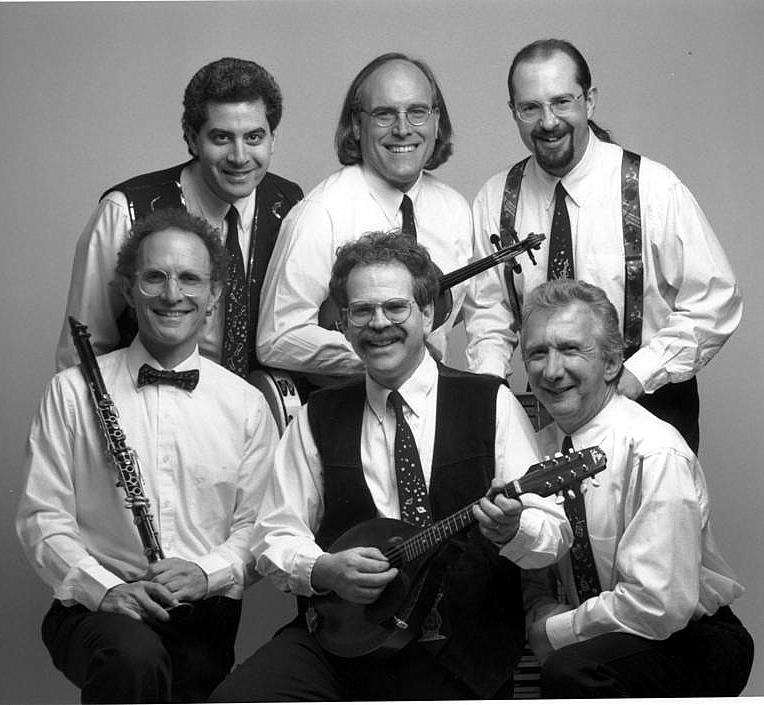
Yiddishe Cup, 1998. An outtake. The arrow in Irwin's head messed up this shot. (Photo by Charles J. Mintz)
—
* Footnote: Yiddishe Cup did not play a Cleveland Heights street fair in 2010. However, the band did play Parade the Circle in University Circle — close to, but not in, Cleveland Heights. And last year the band played for the outdoor movie/concert night at Coventry (Cleveland Heights).
—-
2 of 2 posts for 9/8/10.
L’shana tovah. (Happy New Year.)
Yiddishe Cup is at Fairmount Temple Wed. Sept 29 and Park Synagogue Thurs. Sept. 30 for Simchat Torah. Cleveland.
September 8, 2010 4 Comments
TO KUGEL
Yiddishe Cup’s biggest fan is Lea Grossman.
She got us a gig at The Ark, the premier acoustic music club in the Midwest. She kugel-ed The Ark’s program director. She delivered a noodle kugel to his office in Ann Arbor, Mich. He liked it and he hired us. (Hopefully our music had something to do with the booking too.)
I had been avoiding Ann Arbor. I had attended college there during the hippie era and hadn’t learned much. There had been a quasi-ban on book learning. The foreign language requirement had been oppressive, according to protestors, and the Psych teaching assistants led T-Groups and gave everyone A’s. Until I signed up. Then it went to pass/fail.
When my kids started looking at colleges, I told them Michigan was a swamp. Too big, too impersonal.
I even rooted for Ohio State over Michigan. I harbored some serious animosity toward the Blue. I told Michigan to stop sending me alumni mail. But for $75 I hedged and sent a donation every year. You never knew.
Thanks to Yiddishe Cup super-fan Lea Grossman, I wound up back at Michigan big-time. Lea is 60-something but gets around like a coed, and she promoted our band to everybody and helped put signs on every phone pole. The woman can dance, party and cook. She knows every Jewish dance, and has sung “Tumbalalaika” on stage with Yiddishe Cup at The Ark.
Lea lived near North Campus in a university-affiliated retirement community. It was like a dorm for seniors — real seniors. North Campus — the last time I had been there — had been a music school, a smattering of grad student housing, and one undergraduate dorm. It had been the end of the earth. You had to take a bus to get there. (Still do.) The dorm was called Bursley, as in “brrr, it’s cold.”
For Yiddishe Cup’s first Ark appearance, I picked January. Not too many rational Clevelanders scheduled weddings in January, so we had an opening.
Ann Arbor’s weather was just like Cleveland’s. Bad. And we got a huge crowd at the club. That was weird. The difference between Cleveland and Ann Arbor was Michigan had a puffy coat brigade. The worse the weather, the more the puffy coaters came out. It was almost an Upper Midwest can-do chic — like something from the Progressive Era — a bunch of irregular Jews in irregular puffy coats.
On our first Ark gig, my youngest son stayed in the North Campus dorm, Bursley. He was in eleventh grade. (He also played drums on the gig.)
He liked the school and wound up at Michigan.
So I returned to the swamp– to see my son, and play gigs. (My other kids went to small liberal arts colleges.)
I couldn’t get the Michigan Daily to write up Yiddishe Cup. Ever. I tried. The reporters wouldn’t return calls. Maybe they weren’t too crazy about talking to a middle-aged klezmer guy.
When I had been a Daily reporter, I had enjoyed the John Lennon and Miles Davis assignments but not the local-angle profiles, like when I wrote up the Discount Records clerk who played sax. (That sax player, Steve Mackay, was good, and cut some records with the Stooges later.)
Lea didn’t know who to kugel at the Daily; the Daily reporters were always rotating in and out. They missed a good dish.
Lea moved to New Jersey a year ago.
—-
“To Kugel,” this post, first appeared in the Washtenaw (Ann Arbor, Mich.) Jewish News, Dec. 2009/Jan. 2010.
—-
Check out the new video clip “Driving Mr. Klezmer,” live from The Challah Fame Cafe. The Klezmer Guy blog exits the loch (your computer). Klezmer Guy walks and talks. Rated scary.
—-
Yiddishe Cup plays The Ark, Ann Arbor, Mich., 8 p.m. Sat., Jan. 23. Guests include Hawaiian guitarist Gerald Ross, comedian Seymour Posner, and members of the soul/klez band Groove Spoon.
January 6, 2010 3 Comments
FISHY
1. JEWISH FORK-LORE
Musician Mickey Katz called chocolate phosphates “Jew beers.” He drank them at Solomon’s on E. 105th Street.
I drank mine at Solomon’s at the Cedar Center shopping strip, where Solomon’s moved to.
For some Semitic semantic reason, goys occasionally called Cedar Center the Gaza Strip. Now it kind of is. The north side of Cedar Center is concrete chunks and gravel heaps. A real estate developer knocked down the 1950s-era plaza and plans to redevelop. Who knows when.
Solomon’s was my family’s deli of choice. My father, Toby, was a “deli Jew.” In the Jewish world, that’s usually a putdown, meaning the person knows more about corned beef than Rashi. Toby’s favorite food was a “good piece of rye bread.”
Toby, a phosphate fan, probably didn’t drink more than a dozen real beers his whole life. He should have. In his retirement, when he drank booze he smiled a lot more. A bit shiker at one party, Toby teed off on a watermelon fruit bowl with a golf club. That stuck with me. [Shiker is drunk.]
Toby grew up in a deli. His mother had a candy store/ deli at E. 118 Street and Kinsman Road. She sold it to her half-brother when he came over from the Old Country. Something fishy about that deal — something involving the half-brother’s wife. My grandmother went from candy store/deli owner to simply candy store owner. Not a lateral move.
At the Gaza Strip, there was also Corky & Lenny’s. (Still around — four miles east.) A couple small Jews hung out in the rear booth at Corky’s. One was Harvey, who did collections for a major landlord. (Major, to me, means more than 1,000 units.) I knew Harvey from junior high.
He sued my mother. My mother, for health reasons, moved from her Beachwood apartment after 27 years into an assisted living facility. She had a couple months left on her lease. Harvey, who represented the major landlord, went after her. Harvey’s boss, by the way, loved my band. So what. My mother was collectable.
Freelance journalist David Sax just wrotea book about the decline of delis. Here’s something for the second edition, David: Delis went downhill when they added TVs. Now you have to watch the Browns while you eat.
I was deli-famous. At Jack’s Delion Green Road, I had a thank-you note up in the entrance. My letter was about the terrific tray for my firstborn’s bris. Fatherhood was about buying huge quantities of smoked fish. What a blast. (I ordered the exact same tray for my daughter’s naming.)
I complimented Jack’s Deli on its fish, which my Aunt Bernice, The Maven, also liked. I mentioned “The Maven’s seal of approval” in my letter. Bernice work for a food broker and knew food.
My letter was up for a couple years.
—
(Acknowledgment to Henry Sapoznik for “fork-lore” in this story’s title.)
***
2. ’DINES
The trend at mass-feed kiddushes (post-service temple chows) is toward Israeli foods: hummus, baba ganoush, Israeli salad.
When you privatize — and don’t invite the whole congregation — you typically add some fish.
All Jews like a good piece of fish: lox, smoked fish, herring, the occasional sardine.
My youngest son recently called from Trader Joe’s in Ann Arbor, Mich., and said, “Don’t get excited, Dad, but do I want the sardines in oil or water?”
“Oil.”
I did get excited. My college kid was finally getting into ’dines.
My mother had given me about eight cans of ’dines when I went off to college. I ate them on Sunday evenings, when the dorm cafeteria was closed. (This was back when sardine cans opened with a key, and the ’dines were Portuguese — not Moroccan like now.) Surprisingly – to me at least – the guys in the dorm wouldn’t share my ’dines. Pizza time.
I liked all kinds of ’dines. Even the monster-size sardines in tomato sauce were OK. Bones, no bones . . . no matter. Cajun sauce, soya oil, olive oil, mustard sauce . . . all good. Four ’dines in a can, two in a can . . . either way.
Anchovies? Also, an excellent choice. Make sure you buy your anchovies in a bottle; they last longer than in cans.
Herring in wine sauce. Beware. Last month Heinen’s supermarket substituted Vita brand for Golden Herring. That was lamentable. Vita is too sugary.
At luncheons, the other Yiddishe Cup musicians don’t seem to appreciate the fish (i.e., the “dairy spread” in kosher parlance) as much as I do. Yes, they like the lox. Lox is apple pie. But the other items (smoked fish excluded) get little play from the band. You should see the mountains of herring left over.
October 21, 2009 17 Comments
KLEZ CZARS
Klezmer bands are often run like dictatorships because klezmer music originated in Eastern Europe — a part of the world notorious for autocrats. Or so hypothesized Walt Mahovlich, the leader of the renowned gypsy-style band Harmonia. Walt is an expert on Eastern Europe. His full name is Waltipedia. Maybe.
Walt used to be in Yiddishe Cup. Technically he still is. He is on a leave of absence, which he requested 13 years ago. Walt likes to keep his options open.
If you run a band as a democracy, you’ll be in total disarray on the bandstand, Walt said. I had a musician who liked to call tunes for me. Drove me nuts. Luckily he moved out of town 19 years ago.
Yiddishe Cup’s keyboard player, Alan Douglass, occasionally requests songs. More often, he requests not to play a certain song. For instance, he does not like playing “balls out” (hard-driving) music during guests’ meals. Sometimes I agree with him, sometimes not. These folks — at bar mitzvah luncheons — are comatose from a three-hour shabbat service followed by a 30-minute kiddush (post-service schmooze). Sometimes they need a bracing shot of high-proof klez.
Some musicians have trouble with bandleaders’ czar-like behavior. My guys — not so much. Yiddishe Cup’s musicians are the best in Cleveland; they get paid the most; and they generally cooperate. If I have a problem with a guy, I’ll talk to him alone, not in front of the others.
Craig Woodson, a veteran drummer, taught me not to air private grievances in public. Craig, too, believed in the benevolent monarch thing. He had worked with a king — Elvis. (Check Craig out in the movie Clambake.)
Craig was Yiddishe Cup’s second drummer. He was good — and in California too often on his own gigs. Yiddishe Cup went through a ton of drummers. Our current drummer, Don Friedman — who has been with us 13 years — knows how to keep time and add tasteful fills. So does our alternate drummer, a yingl (boy) named Diddle.
Diddle, 21, started “playing out” (gigging) when he was 13. I hate that — that start-out-as-young as-Mozart-or-you’re-toast mentality. Diddle’s father hangs around our gigs, kind of like Venus and Serena’s dad.
Cleveland’s jazz king Ernie Krivda played in his dad’s polka band at 13. Clarinetist Ken Peplowski played in a polka band at 13. Joe Lovano started the sax at 5. “At 16 the young Joe Lovano got his driver’s license and no longer needed his father, Big T, to drive
him . . .” blah, blah.
My father was a “Big T” too. Toby. Why didn’t he have a band? Or at least a decent record player.
—-
1 of 2 posts for 9/2/09. Please see post below too.
—-
Yiddishe Cup concert 7:15 p.m. Sun., Sept. 6, Orange Village (Ohio) gazebo.
September 2, 2009 3 Comments
“OPEN MIC” FRIGHT
On our thirtieth wedding anniversary trip, my wife, Alice, and I were in a small town, Creel, Chihuahua, northern Mexico, along with a lot of federal cops. Some of them were crowded around a store window that had bullet holes in it. This was déjà vu for me; I used to rent to the U.S. Armed Forces Recruiting Center, which always had its share of bullet holes, plus red food coloring, red Jell-O and toy baby doll arms piled in the doorway. I never billed the government for cleaning up.
The Mexican federales wore all black. Some had masks, so the drug cartel boys wouldn’t recognize them. Other than that, Creel was like Put-in-Bay, Ohio: a resort town with tchatche shops everywhere. And there was a coffeehouse, featuring an open mic night, in the Best Western.
I often pack a harmonica when I camp— and we had just spent a few days in the Copper Canyon mountains — so I did a blues harmonica ditty at the open mic. An American, Diddle, backed me on guitar.
After this cross-cultural interlude, my wife and I walked past the store with the bullet holes again. We heard a “rat-a-tat-tat.” No, a “pa-pa-pa-pa-pa.” We ducked and ran like Groucho Marxes. We wound up on the floor in a nearby hotel lobby, where a clerk jabbered about how she had never been so frightened in her whole life.
Me too.
And I had just paid thousands of dollars to get shot at. At least in Israel it would have made some sense — solidarity with my people and all that.
How was your trip, Bert?
Nice except for getting shot at.
June 12, 2009 2 Comments
SKUNKS
Another negative in the music biz: party planners. (Not to be confused with event planners, who are typically business-like, big-time and helpful.) These party-planner ladies poke into my freylekhs (hora) time, giving me hand signals like quarterback Frank Ryan, as they scream: “The soup is getting cold! Stop the music!”
I ran into a party planner in D.C. who was flashing so many fingers, I thought she was trying to land an airplane.
I try to ignore these women. I know how long “Hava Nagila” should last, and screw the kitchen staff and their perishable salads they want to “plate.” Basically, listen to the person with the checkbook. If the client wants a 20-minute hora, she’ll get 20, even if the party planner says 15. One time the dad wanted 45 minutes; the mom wanted 30; and the party planner called an audible at 15. Naturally I followed the dad. He was writing the check, and he loved the set.
Party planners, in real estate terms, are “tenants from hell.” Do the math: The party planner = the tenant who paints her walls turquoise and brings in four cats and then lobbies for a skunk. “But it’s denatured,” the tenant says.
Go buy your own apartment building and fill it up like the Cleveland Zoo. Not everybody wants to see a skunk walking down the hallway.
Rewind: Party planners are frequently hard-working, talented people. They dress chicly in black and know something about everything, from lighting to matzo balls. Musicians think the party revolves around the band. Actually, the party revolves around the newlyweds or bar/bat mitzvah. Note to wedding musicians: You are not on stage at Nautica. You are in a service industry. You can be replaced by a DJ in a second. In fact you’re fired.
—–
Tomorrow:
WHAT SIDEMEN? . . .When the gig is bad, the client comes to the leader, not the sidemen. Sidemen are invisible.
May 14, 2009 4 Comments
